
To start: A humble request that we put more thought into Territorial Acknowledgements in relation to Indigenous Epistemology.
It has become commonplace for public gatherings, email signatures, and mission statements to be in the form of a territorial acknowledgment. These rehearsed statements acknowledge that we are “gathered on Treaty 6 Territory” (University of Alberta’s endorsed 2012) or that we are on “unceded territory” (University of British Columbia) and it just seems like it’s missing the point. Those who acknowledge treaties, over people, and acknowledge unceded territory, but ignore Indigenous inherent rights, are fundamentally performing.
So today, I currently study next to what the Nehiyawak call swift-flowing river, kisiskâciwanisîpiy, at a space once known as Beaver Hills House or Amiskwaciy Waskahikan. I want to acknowledge the space I am in. There are many Indigenous peoples who occupy this Land and will continue to occupy this Land. Attempting to list or categorize those Indigenous peoples, does harm in suggesting that the Land, does not willingly provide for an infinitely diverse people across time immemorial both past and future.
Alternatively, I want to take a moment to recognize that we occupy Land enslaved through coercion. Some territorial acknowledgements simply acknowledge treaties. This understanding is reductive and fails to acknowledge a commonly held Indigenous perspective that the treaties were not upheld, and much more significantly that Land is a being with their own inherent rights and cannot be owned. Indigenous people live in relations to Land as if they were a member of their family.
My Land Acknowledgement for where I am, October 2021
Anishinaabe scholar Leanne Simpson says that we must start with ourselves and work our ways outwards (Leanne Simpon, “Looking after Gdoo-naaganinaa,” Native Historians Write Back 2011, p96). Telling people about myself used to be easy, I would start off by saying I was born in Whitehorse and was raised in Cawston, BC. Today, it’s more complicated because I am a member of the Atikameksheng Anishinaabe nation. By birth, I am considered a member of an Indigenous nation, yet the blood quantum argument has already been dismissed by Indigenous epistemology.
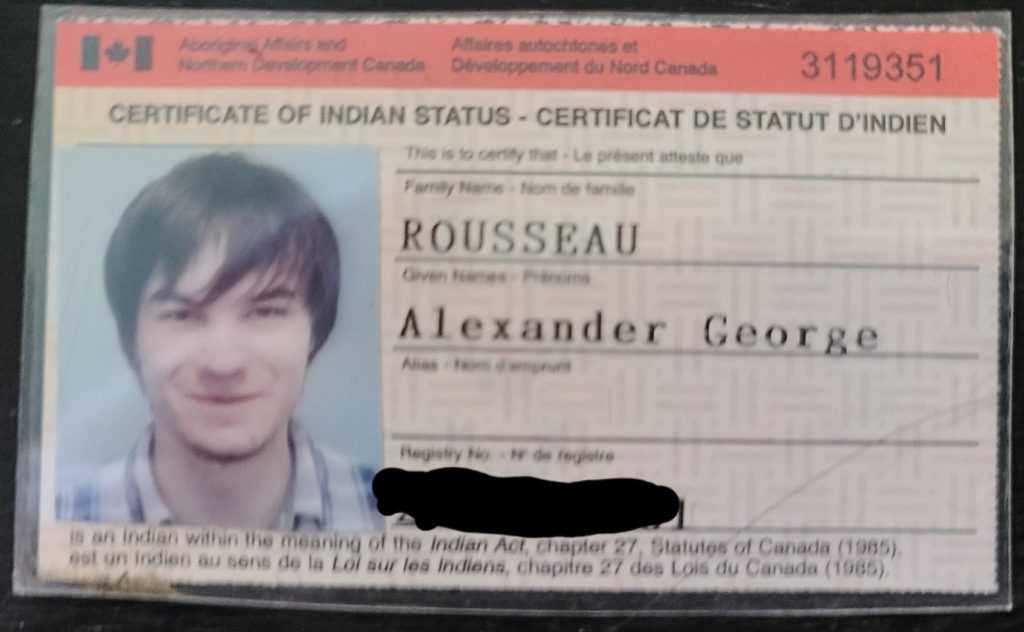
I asked this question of my dad, who unlike me was born much closer to our ancestral Lands in Sudbury, Ontario, a place I have no memories to call upon. I said: “By the academic definition of Indigenous currently, we aren’t Indigenous.” My father responded with no hesitation something along the lines of: “The Anishinaabe people had messengers all over this continent.” (I had a few drinks, so don’t let me speak for him, but considering that Anishnaabe speaking people in Canada are recognized in Treaty 8 Territory, I’m inclined to believe this memory.)
I remembered the words of Dr. Margaret Kovach, a Nêhiyaw and Saulteaux scholar, who says: “start where you are” (Indigenous Methodologies: Characteristics, Conversations and Contexts, p10). I had spent so much time being told by territorial acknowledgments that I convinced myself that I was not welcome in my home, but it felt so affirming to have my father say that we are home. Thus I must attempt to reconcile my own Indigenous identity with my relationship with the Land which raised me. Following the Anishnaabe epistemology which is echoed in larger Indigenous Epistemic discourse, my identity as an Indigenous person starts first with the self, then works outwards to family. Thus Indigenous identity should not strictly be tied to ancestral territory, but with a relationship with the Land. I am convinced I have and strive to live in good relations with the Land that raised me. Thus, I must conclude that when territorial acknowledgments aren’t informed frequently enough by Indigenous epistemologies they inadequately recognize Indigenous understanding of the relationship between Land and people.
Territorial acknowledgments appear caught in a transitory phase in which people incorrectly perform these tasks without adequate internalization of the concepts. I would be inclined to call it a form of performative justice in which those who are not fully committed to the cause of Indigenous rights are allowed to sidestep commitment with a rehearsed speech of reconciliatory language, but fails to externalize intention.
It is not my intention to critic people’s steps towards reconciliation, but Indigenous people have been victims of performative justice for over a hundred years now. Currently, Justin Trudeau is under criticism for taking a vacation during the National Day for Truth and Reconciliation. Justin Trudeau released a statement that he spent some of his days conversing with survivors of Residential Schools, but he ignored requests from leaders of the Tk’emlúps te Secwépemc for him to attend ceremonies at the Kamloops First Nations.
On Facebook, I commented that 111 years ago, Prime Minister Laurier ignored requests from the gathered Chiefs at Kamloops in 1910. I have hopes that this generation of Prime Ministers can listen better, but our prime ministers have a poor history of listening to Indigenous peoples. One need look no further than the conservative predecessor: Stephen Harper’s apology was followed alongside the quashing of the Kelowna Accords, an agreement meant to enact many of the recommendations of the Truth and Reconciliation Commission.
I may be misguided, misinformed, but I hold no malicious intentions. If you disagree with anything I say, in the spirit of reconciliation, let’s have a discussion.
Miigwetch,
Alex
