
Hello, I’m Alex.
I’m a second-year Master’s Student at the University of Alberta. I am pursuing a degree in History, something I often argue is underappreciated and ignored by most people. My research is aimed at deconstructing Western expectations in History to reorient and bring in Indigenous perspectives, starting with Local History.
I am a member of the Atikameksheng Anishnaabe, born in the Whitehorse Hospital, next to the Yukon River, the traditional territory of the Kwalin Dun and Ta’an Kwäch’än people. I moved when I was six and was raised along the Similkameen River, the traditional territory of the Smelqmix of the Sukwnaqin-x. Their territory and people provided me with many of the opportunities that made me who I am today. I do not thank them enough for their hospitality and the nurturing they provided for me.
I completed my History Honours Degree at the University of British Columbia at the Okanagan Campus in 2020. I was blessed to have finished my undergraduate thesis before lockdown and is available through UBC’s cIRcle. I had researched the United States Military Academy, an institution that produced American heroes such as President and General Ulysses S. Grant, Scientist Alexander Bache, and General and University President, Robert E. Lee. A funny question I often asked myself while doing the research was, “What is this injun boy from British Columbia doing research about the United States Military Academy.” But, I had reached out to the author of Designing Gotham: West Point Engineers and the Rise of Modern New York, 1817-1898, John Scott Logel, a professor at the US Naval War College and a member of the Long Grey Line: A West Point Graduate. I had informed him I had completed my thesis and it was available at the link above, and he encouraged me to do more research on the subject. Soontm
I had pursued a project with the United States Military Academy because I had no supervisor available for the project I actually wanted to research: Indigenous Participation in the World Wars. The current Canadian historian wasn’t taking new students, but the professor who suggested I look into an honours thesis, Dr. Julien Vernet, was willing to supervise my study of the United States Military Academy.
In the end, it took me 6 years to achieve a bachelor’s degree, beginning in 2014 as a Bachelor of Science student. I quickly found out I didn’t like science enough to want to retake calculus, physics, and chemistry, because I had already taken first-semester calculus in high school, but it didn’t transfer because it wasn’t an AP course. After the first year, I was put on academic probation and then ordered to “discontinue from faculty” on academic probation for one year. Outside of the university, this means I flunked out. Instead of spending a year away from school, I decided to attend Okanagan College. Had they offered a four-year degree I would have stayed. Unfortunately, they do not and so after two years at OC, I returned to UBCO in which I spent a lot of time learning by trial and error how to succeed in my studies.
Even as a Master’s student, I still can not claim I am a great student. In accordance with sharing my experience through learning. I aim to share that experience and will be sharing my essays, and my successes, musing of a lost mind and attempting to make the best of all that life has thrown at me.
Although when I originally wrote this, I presented myself as a student only, I should acknowledge that I have far more interests than just school. A lot of my interest in history stemmed from an interest in historical video games such as Total War and Assassins Creed. I have plodded through school on half a passion, missing the dream and plan. I had imagined maybe I could work on video games one day, but the dream was to be an educator. I was asked, was actually in a belt test when I was in Kyokushin Karate: “What do you do this for?” or something along those lines by my Sensei, and I responded: “I want to be where you sit right now.”
My math teacher had told me I’d make a good engineer, I like to think it was because I excelled at trigonometry, but unfortunately, my path wasn’t into the applied sciences (Although I was accepted into the School of Applied Sciences, late.) I turned to one of the other classes: Social Studies, and History.
My university degree is made of an amalgamation of required electives (oxymoronic I know), English, Political Science, History, and Indigenous Studies. When I finally set on history when I went to Okanagan College, I had pondered about minoring in Political Science: My political science professor really helped me see myself as a viable student. I took far too much of her time in her office but really, she’s another person I don’t thank enough.
But I never minored in anything, I decided to pursue an honours degree instead. Although I was one or two classes from getting a minor in Indigenous Studies, I stumbled into the capstone class for the Indigenous Studies program, it was a course on the Application of Indigenous Methodologies, it built on another class that was supposed to be taken before it. To my surprise.
But it reflected a class I had to take for my Honours Degree: HIST495: A class on social science and historical methodology which was a class partnered with graduate students. Both classes taught me one thing: History is not an Indigenized field of study.
So I did the only logical thing, applied to graduate school equipped with an Honours Degree in effectively American History and a whole lot of good intentions towards Indigenous History. I dove headfirst into three new fields that needed to be brought together: Canadian, Indigenous, and Military History. All three are robust fields, in which you may find a common understanding between Canadian Military History, or Canadian History, and maybe Canadian-Indigenous History: But they struggle to reconcile with Indigenous History.
My belief is that there is a critical disconnect in our education, in which we are not empowered with the truth, and I am to utilize my research, my work, and my passion to empower myself, my family, and my friends. My current goals are to build help my partner builds a publishing house in which empowers, rather than exploits authors; to build my own business and business model that centers on Indigenous and social-capitalist ideals, and to become an educator and mentor for future generations. As this is a holistic Indigenous model, I see these things as invariably intertwined with Anishnaabe belief that we must start from the self, and move to the family, clan, tribe, community, and onward. I aim to create a model in which acknowledges our diverse strengths and incorporates them as much as possible.
Miigwetch, to all my Relations, Known and Unknown.
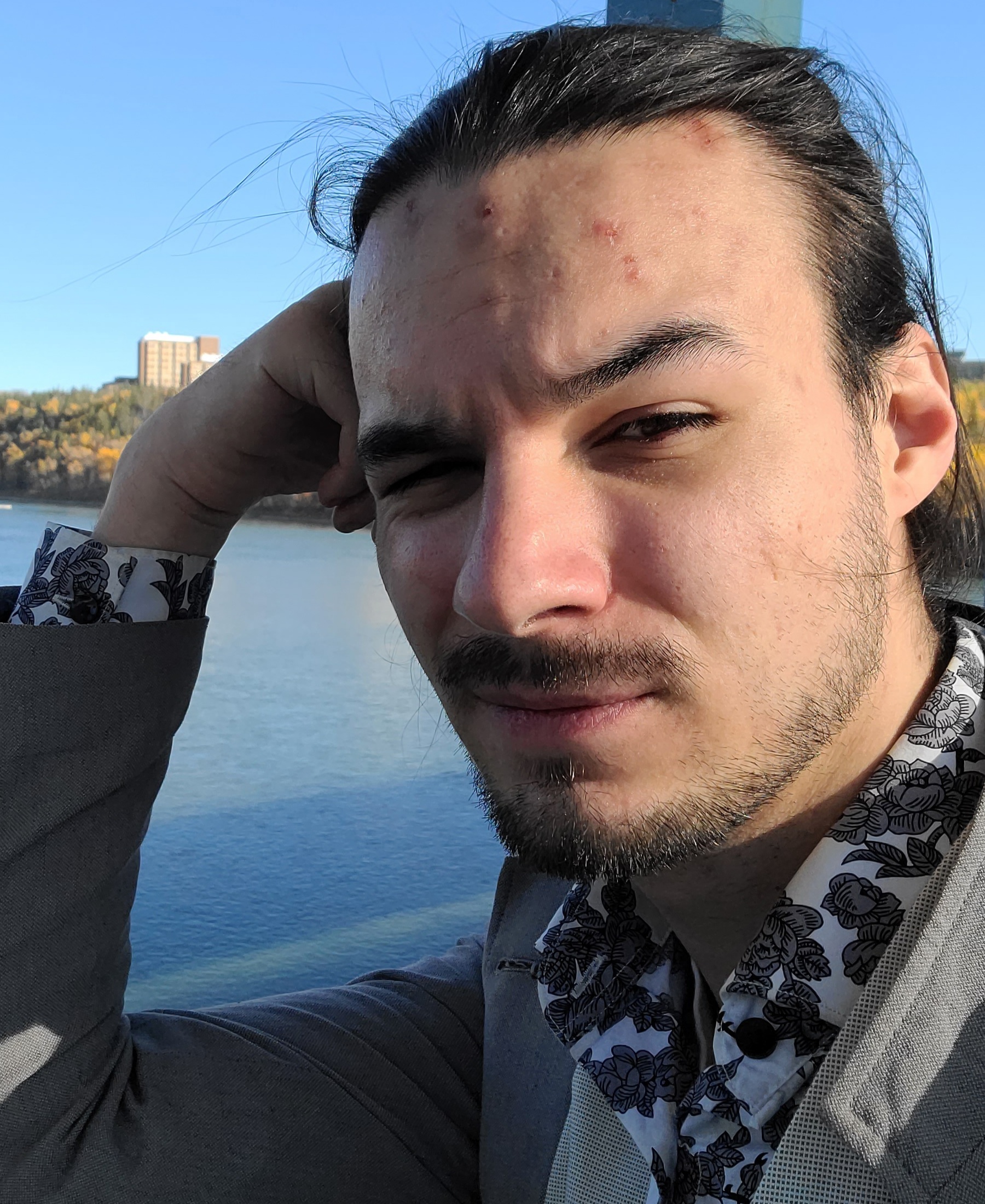
Me 2021 with my own self-facing camera on the highwater bridge. 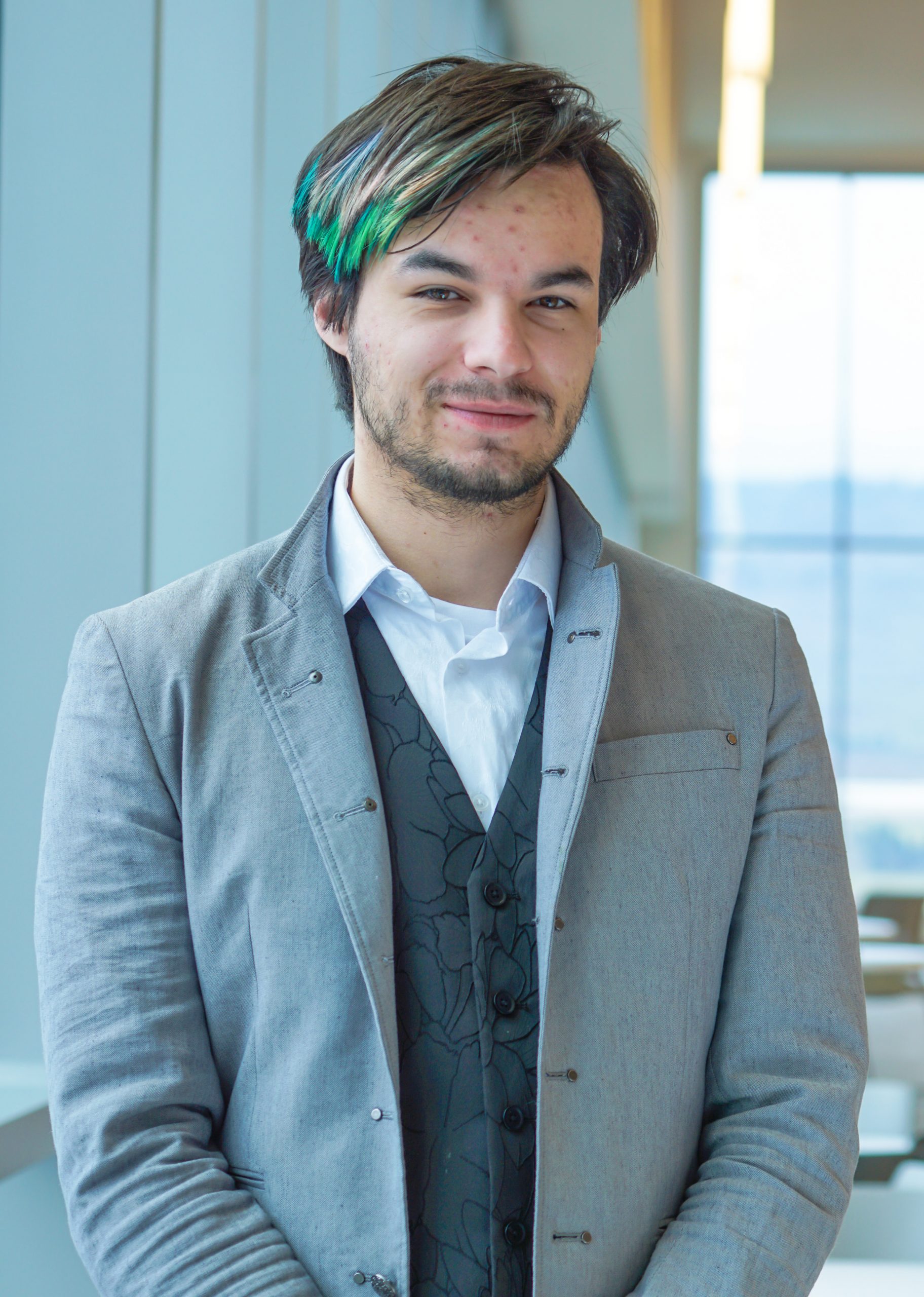
Me in 2019 at a Career Workshop at the insistence of Dan Odenbach from APS. They got an excellent picture of me.